Impact
A Bigger Scientific Problem Space
The key outcome was not simply faster hardware. The new servers allowed HudsonAlpha to process jobs that previously had to be divided and reassembled, reducing very large assembly timelines and opening additional genomic work to practical analysis.
Fewer Splits
More of a genome can be processed as one large working set.
Fewer Splits
More of a genome can be processed as one large working set.
Fewer Splits
More of a genome can be processed as one large working set.
Faster Runs
Very large assembly workflows moved from month-scale toward day-scale execution.
Faster Runs
Very large assembly workflows moved from month-scale toward day-scale execution.
Validated Results
Testing before purchase helped confirm both speed and reliability for production research.
Validated Results
Testing before purchase helped confirm both speed and reliability for production research.
Validated Results
Testing before purchase helped confirm both speed and reliability for production research.
Impact
A Bigger Scientific Problem Space
The key outcome was not simply faster hardware. The new servers allowed HudsonAlpha to process jobs that previously had to be divided and reassembled, reducing very large assembly timelines and opening additional genomic work to practical analysis.
Impact
A Bigger Scientific Problem Space
The key outcome was not simply faster hardware. The new servers allowed HudsonAlpha to process jobs that previously had to be divided and reassembled, reducing very large assembly timelines and opening additional genomic work to practical analysis.
Customer Story • Genomics
HudsonAlpha Genome Sequencing Center
Large-memory HPC for a 20× jump in sequencing data
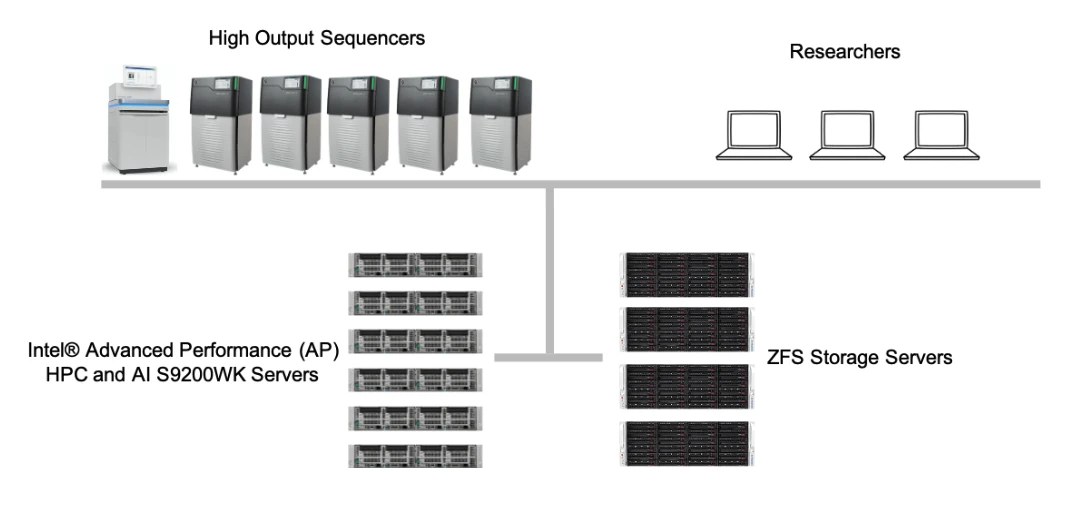
Rapid growth in PacBio and Illumina sequencing output created a compute and memory challenge: HudsonAlpha’s plant-genomics workflows were becoming too large and complex for conventional HPC nodes to process efficiently.
ADS validated a large-memory Intel Advanced Performance server architecture against HudsonAlpha’s real computational work before purchase.
Request a Consultation
20×
Increase in sequencing analysis throughput demand
12
Intel Advanced Performance servers deployed
192
Total CPUs across the deployed servers
Months → Days
Reported reduction for very large assemblies
20×
Increase in sequencing analysis throughput demand
12
Intel Advanced Performance servers deployed
192
Total CPUs across the deployed servers
Months → Days
Reported reduction for very large assemblies

“ADS customized systems for our exact needs, selecting from the entire universe of technology providers, and worked with us to put test machines in place in order to verify that our unique computational work and algorithms are producing reliable results at the speeds HudsonAlpha needed.”
Jeremy Schmutz
Faculty Investigator, HudsonAlpha Genome Sequencing Center

The Challenge
Plant Genomic Sequencing Does Not Behave Like a Typical HPC Job
HudsonAlpha’s laboratory work generates large, complex genome data sets. New sequencing instruments increased the amount of data flowing into the computational pipeline, while plant genomes often require larger memory working sets than conventional simulation-oriented HPC nodes provide.
The team needed enough memory bandwidth and local capacity to keep large assemblies in RAM and enough processing resources to move each stage of the analysis pipeline efficiently.
WHY STANDARD NODES STRUGGLED
Large Working Sets + High Data Rates
The Challenge
WHY STANDARD NODES STRUGGLED
Large Working Sets + High Data Rates

The Challenge
Plants, Like Sugarcane, Have Highly Complex Genomes
The Solution
Intel Advanced Performance Servers, Staged and Validated by ADS
ADS recommended and staged a large-memory architecture so HudsonAlpha could test its real algorithms before committing to production systems.
COMPUTE
High Core Density
The deployed systems used Intel Xeon Platinum 9200-class processors, providing a dense CPU platform suitable for highly parallel genomic analysis.
MEMORY
High Memory Bandwidth
A wide memory-channel architecture helped keep large genome data resident and accessible to the analysis pipeline.
VALIDATION
Pre-Purchase Testing
ADS staged recommended systems in its integration facility so HudsonAlpha could verify performance and scientific correctness before deployment.
SUPPORT
Operational Continuity
Fast warranty handling and a single support path helped a research environment where keeping compute resources productive matters every day.
Genomics Infrastructure
Need Compute Sized for Your Sequencing Pipeline?
ADS can model memory, CPU, storage, and data movement around your actual bioinformatics workflow.
Request a Consultation
A Global Leader in Plant Sequencing
The HudsonAlpha Genome Sequencing Center laboratory and computational staff are considered among the world leaders in plant sequencing, genome assembly, improvement, and data analysis. The HudsonAlpha Genome Sequencing Center is one of the world's major centers performing original sequencing of plants and humans. The center specializes in applying genomic techniques to understand how plants function in response to environmental changes. Their gold-standard plant reference genomes are used by over 20,000 researchers worldwide.
Applied Data Systems has been a trusted supplier of advanced computing technology to the HudsonAlpha Genome Sequencing Center. HudsonAlpha recently needed to purchase new computing technology to keep up with its exploding sequencing workload – a workload that couldn’t even be addressed by the United States’ national supercomputing resources.


Applied Data Systems
©2026 Applied Data Systems